
Small pig breeds are growing popular among pet owners and small-scale producers. Do you know which pigs stay small and can live in a range of environments?
Small pig breeds such as the Potbellied Pig, Juliana, Gottingen, and Miniature are known to stay small and weigh less than 300 pounds. They are noted for being amiable and low-maintenance. They also have a long lifespan, making them a long-term commitment as a pet.
If you want to learn more about small pig breeds, read on to learn more about their characteristics, common breeds, care, maintenance, and more.

Characteristics of small pig breed
Physical characteristics
Small pig breeds, as the name implies, are distinguished by their small size and weight. They weigh less than 300 pounds on average, with some breeds weighing as little as 50 pounds. With a short nose and a round, stocky body, they have a compact and strong structure.
Their legs are likewise short, giving them a low-to-the-ground appearance. They have a thick covering of fur that can vary in color and pattern.
Most little pig breeds are under two feet tall at the shoulder. Some small breeds are only one foot tall. Their head is proportionate to their body, with small, erect, or drooping ears. Typically, the tail is short and curly.
Tiny pig breeds are generally ideal for small places and are easy to handle. They are also less destructive than larger types and more easily trained.
Temperament and personality
Small pig breeds are well-known for their social and amiable attitudes. They are intelligent animals who appreciate human interaction and can be very affectionate towards their owners. Small pig breeds are also quite easy to train, and with positive reinforcement, they may learn a variety of orders and tricks.
Furthermore, small pig breeds are also known for their lively personalities, which can sometimes be amusing. They like exploring their environment and are open to new experiences. They can communicate through various grunts, squeals, and other sounds.
Small pig breeds are also well-known for being low-maintenance. They are usually satisfied to lie around and relax for extended periods and do not require much activity or stimulation. They are also fairly clean and may be litter trained.
Other notable traits
Small pig breeds have various distinct features that make them useful for diverse purposes.
As said, tiny pig breeds are low-maintenance. They can lie around and relax without much activity or space. They are ideal for pet owners with limited time and resources.
Small pig breeds may adapt to many situations. They make good indoor or outdoor pets and small-scale farmers. They may survive in urban or rural climates.
Small pigs also live up to 15 years. They’re long-term pets, so consider this before getting one.
Regarding feeding efficiency, small pig breeds convert feed into meat more efficiently than larger breeds. This is due to their lower FCR (Feed Conversion Ratio).
Smaller pig breeds have less environmental impact. They squander less land, feed, and water. They emit less CO2.
Small pig breeds yield high-quality meat. Their lean, well-marbled meat makes them versatile.
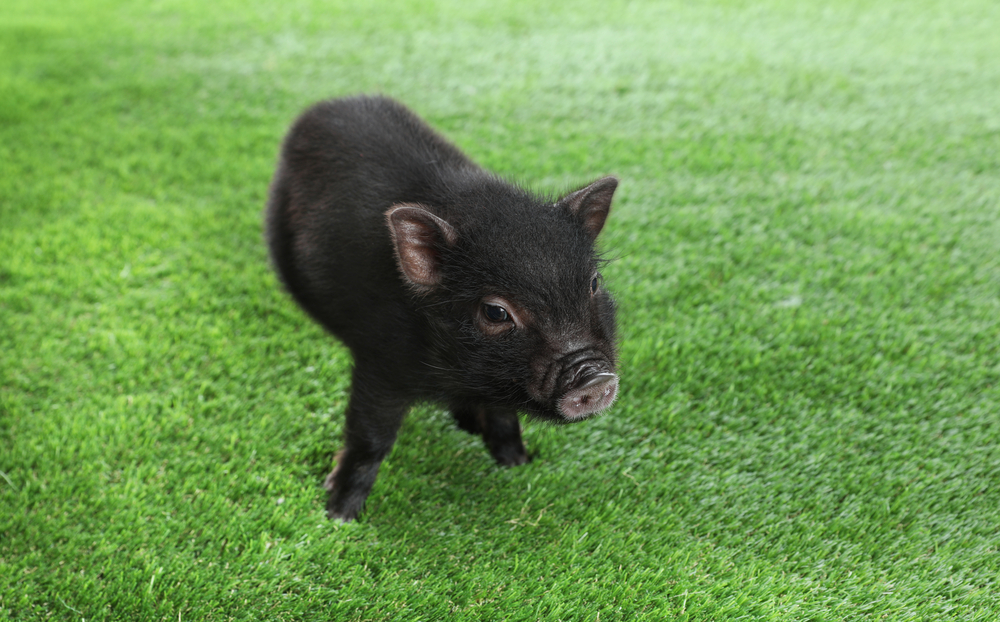
Popular small pig breeds
Juliana
Often known as “Miniature Julianas” or “American Miniatures,” is a small pig breed. They are distinguished by their diminutive size and unique black, white, and sometimes multi-colored markings. At full maturity, they weigh between 50 and 150 pounds and stand under two feet tall at the shoulder.
They are intelligent creatures who appreciate human interaction and are noted for their warm and gregarious demeanor. Julianas are relatively simple to train and may learn many commands and tricks through positive reinforcement. They are also known for their lively personalities, which can sometimes be rather amusing.
Potbellied pig
This is a type of tiny pig that originated in Vietnam. They are distinguished by their modest size and characteristic pot-bellied shape. At full maturity, they weigh between 50 and 150 pounds and stand under two feet tall at the shoulder.
They have a thick fur coat in various hues, including black, white, brown, and spotted. This breed is also amiable and low-maintenance, making them easy to manage and appropriate as pets. They are also relatively easy to train, and with positive reinforcement, they may learn a variety of orders and tricks.
Gottingen Minipig
The Gottingen Mini pig is a miniature pig breed from Germany. They are distinguished by their modest size and unique black-and-white color. At full maturity, they weigh between 50 and 150 pounds and stand under two feet tall at the shoulder.
They are recognized for having pleasant personalities and enjoying human connection. They are also well-known for producing high-quality meat and pork, making them an excellent alternative for raising pigs for meat production.
Miniature Minipig
The Miniature Mini pig, also known as the “Pocket Pig,” “Teacup Pig,” or “Micro Mini pig,” is a small pig breed. They are renowned as the smallest farmed pig breed, weighing between 20 and 50 pounds at maturity and about 12-16 inches tall.
Miniature minipig is a breed that was created by breeding the smallest piglets from various micropig breeds. They are stocky and compact in appearance, with a short snout and a round, pot-bellied body. And have a thick fur coat that can be a range of colors.
Miniature minipigs are amiable and low-maintenance, making them easy to manage and appropriate as pets. They live a long time, making them a long-term commitment as a pet.

Care and Maintenance of small pig breeds
Feeding and nutrition
A combination of fresh fruits and vegetables, a balanced diet strong in fiber and protein, and suitable pig feed are necessary for small pig breeds. Their food should always be fresh and clean, and they should be fed twice a day.
They ought to always have access to fresh water. To avoid obesity and other health problems, providing them with a balanced diet is crucial. Their diet should be designed to satisfy their dietary requirements, which will vary based on the breed, age, and size of the pigs and their degree of activity.
To receive a customized diet that meets your pig’s needs, you should speak with a veterinarian or a pig nutritionist.
Housing and fencing requirements
Small pig breeds need a safe and secure environment to live in. This could be a pen outside or indoors, like a barn or a shed. They should have access to sunlight, clean air, and a location to dig and graze. Ideal for them to graze and explore is a fenced-in space.
Outdoor housing needs to be well-drained and offer protection from severe weather. Pigs also want a cool, shaded location to rest and escape the heat. Indoor dwelling needs to have good ventilation and dry, clean bedding.
The housing of small pig breeds must include fencing. They ought to have a solid fence around them that keeps predators out and is tall enough to prevent them from escaping.
Since pigs have a reputation for being skilled at digging, the fence should be buried deep enough to prevent them from doing so. It’s crucial to frequently inspect the fencing for repairs or upkeep.
Health and veterinary care
Small pig breeds require routine vaccines and veterinary exams to keep them healthy and content. For symptoms of disease, such as coughing, sneezing, or diarrhea, they should be examined. Regular deworming should also be done on them.
Pig breeds are prone to several medical conditions, including parasite infestation, respiratory diseases, and foot issues. They should be checked frequently for any symptoms of disease, and if they do, quick veterinary care should be offered.
It’s crucial to have routine veterinary checkups to ensure the pig is up to date on vaccinations and dewormings and identify any potential health issues early on. The utmost possible care should be given to pigs because healthy pigs are happy pigs.
Training and behavior management
With positive reinforcement, small pig breeds are easy to train. They could learn a range of commands and tricks. They should be trained and socialized from a young age to be well-behaved and easily managed.
Pigs are intelligent creatures that can be taught to answer to their name, come when called, sit, roll over, and even walk on a leash. They can also be taught to be litter trained and to utilize a bell or buzzer to signal when it is time to go outdoors.
When teaching and managing the behavior of small pig breeds, it is critical to establish a constant and positive routine. When they act properly, they should be rewarded with sweets or praise; when they misbehave, they should be gently disciplined.
Summary – What Pigs Stay Small?
- Small pig breeds, sometimes known as micro pigs, are growing in popularity as pets and for small-scale farming.
- They stay small, weigh less than 300 pounds on average, and are considered amiable and low-maintenance.
- Mini pigs are popular pets because of their small size and adorable look, but they require the same care as any other pig and can live for up to 15 years.
- They are intelligent and may be trained to do various activities, including responding to their name, coming when called, sitting, rolling over, and even walking on a leash.
- It is critical to remember that they are live beings, not fashion accessories, and require adequate care and attention.